When people think of flood-prone cities, Rotterdam is usually near the top of the list. Much of the city lies below sea level and is exposed to both river and coastal flooding. Yet Rotterdam is widely regarded as one of the world's most resilient cities when it comes to water management. The reason is not engineering alone. It is a fundamentally different way of thinking about water.
For decades, most cities approached flooding as an engineering problem with a single objective: move rainwater away as quickly as possible through drains, pipes and canals. Rotterdam adopted a different philosophy. It recognised that extreme rainfall events would keep occurring and that drainage systems alone could not handle every storm.
"Where will the water go when the drains are overwhelmed?"
That question — asked not in resignation but as a planning challenge — changed how Rotterdam designs its streets, parks and public spaces. The city stopped trying to eliminate water and started making room for it.
Here are four lessons from Rotterdam's approach that are relevant for Gurgaon.
Lesson 1
Design public spaces to store water, not just look good
Rotterdam's "water squares" are the most visible expression of its water philosophy. These are public spaces — plazas, parks, sports courts, amphitheatres — that function normally during dry weather. During heavy rainfall, they temporarily fill with stormwater, acting as above-ground reservoirs that prevent nearby streets and buildings from flooding.1 Once the rain passes and the drainage system catches up, the water drains away and the spaces return to normal use. Gurgaon has parks, open grounds and sector greens scattered across the city. Many of them flood anyway during heavy rain. Rotterdam's approach asks: what if that were planned, not accidental?
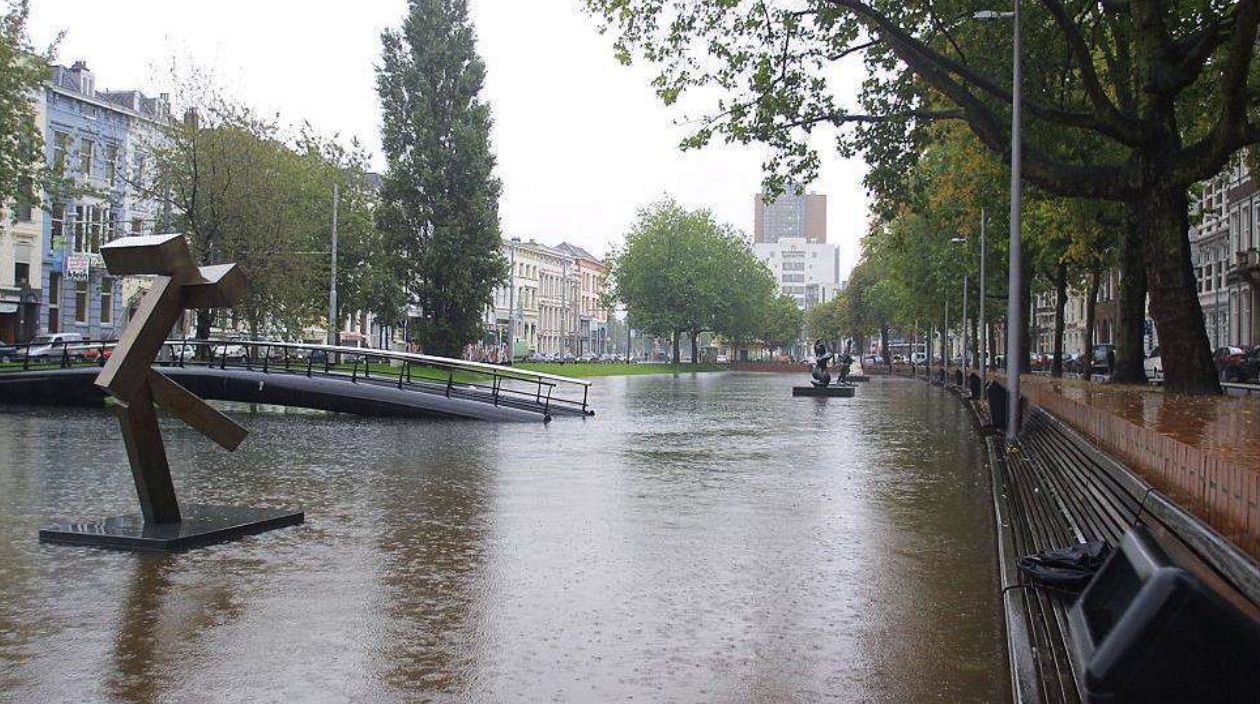
A Rotterdam water square — a public space that doubles as a stormwater reservoir during heavy rainfall, then drains and returns to normal use
Lesson 2
Give rivers and drains more room, not less
The Dutch national programme "Room for the River" — launched after devastating floods in 1993 and 1995 — deliberately widened floodplains, relocated dikes and removed obstacles from river channels to give water more space during extreme events.2 Rather than trying to contain water in ever-narrower channels under increasing pressure, the programme accepted that rivers need room to expand safely. Gurgaon's nalas (natural drainage channels) have been progressively encroached upon, narrowed and built over. The result is that even moderate rainfall overwhelms channels that were originally designed to carry far more water. The Dutch experience suggests the response should be to restore that space, not build higher walls around diminished drains.
Lesson 3
Build flood resilience into neighbourhoods from the start
In Rotterdam, flood management is not a separate infrastructure project commissioned after a neighbourhood is built. It is embedded in urban planning — influencing where public spaces are located, how roads are graded, how rooftops are designed and how new developments handle rainwater on-site.3 Green roofs that slow runoff, permeable paving that reduces impermeable surfaces, and ground-level water features that double as retention areas are all standard considerations. In Gurgaon, new developments have frequently been approved and built without requiring on-site stormwater management. Each new housing complex or commercial development adds more impermeable surface with no corresponding place for the water to go.
Lesson 4
Accept that some flooding will happen — and plan for it
Rotterdam does not promise zero flooding. Instead, it distinguishes between flooding that is dangerous and costly — the kind that enters buildings, disrupts infrastructure and harms people — and flooding that is manageable, because it flows into spaces designed to receive it. This distinction shapes every investment decision.4 For Gurgaon, the implication is that it is not necessary to prevent every puddle. What matters is ensuring that when drains are overwhelmed — as they inevitably will be during peak monsoon — the excess water goes somewhere safe rather than into homes, underpasses and roads.
Gurgaon and Rotterdam face very different challenges. Rotterdam deals primarily with river and coastal flooding; Gurgaon struggles with intense monsoon rainfall concentrated over three months. The scales and contexts are different.
But the underlying insight transfers: flood resilience is not only about building larger drains. It is also about creating places where excess water can collect safely when heavy rain inevitably arrives — and designing cities so that when the system is overwhelmed, the consequences are manageable rather than catastrophic.
As Gurgaon continues to grow, the choices made now about where to build, what to preserve and how to design public spaces will determine how the city handles the monsoons of the decades ahead. Rotterdam's experience is a proof of concept that those choices can make a significant difference.
Check flood risk for your area
FloodWatch covers 721+ localities in Gurgaon with Monsoon Readiness Scores, live advisories, and waterlogging hotspot data.
