Every monsoon, Gurgaon residents ask the same question: if cities around the world receive far more rainfall than Gurgaon, why do our roads flood so easily? One city offers a particularly useful comparison — and its answer has less to do with geography than with decades of deliberate choices.
2,400mm
Singapore's average annual rainfall — more than 3× Gurgaon's
<600mm
Gurgaon's annual rainfall — yet flooding is a recurring crisis
S$2B+
Singapore's investment in drainage upgrades over the past decade alone
Singapore was not always flood-free. In the 1960s and 1970s, flooding was a recurring problem — low-lying kampungs regularly went under water after heavy rain. Rather than treating each flood as an isolated incident, Singapore chose to treat urban flooding as a city-wide infrastructure challenge and invested systematically over decades.
The result: today, normal life in Singapore typically resumes within hours after even the heaviest downpours. The difference is not climate, not luck, and not geography. It is policy and sustained investment.
Here are five lessons that Gurgaon — and India's fast-growing cities more broadly — can take from Singapore's approach.
Lesson 1
Water needs somewhere to go
Rather than viewing rainwater as a nuisance, Singapore built an integrated network of reservoirs, canals, retention areas and drainage systems designed to capture, store and move water safely.2 The most visible example is the Marina Barrage — a structure that serves simultaneously as a freshwater reservoir and a flood-control gate. During heavy rainfall, excess stormwater is discharged into the sea through pumps and gates before it can accumulate in low-lying parts of the city.3 Gurgaon has moved in the opposite direction: 389 of its 640 traditional water bodies have been lost in 70 years,1 eliminating the natural storage that once gave rainwater somewhere to go.
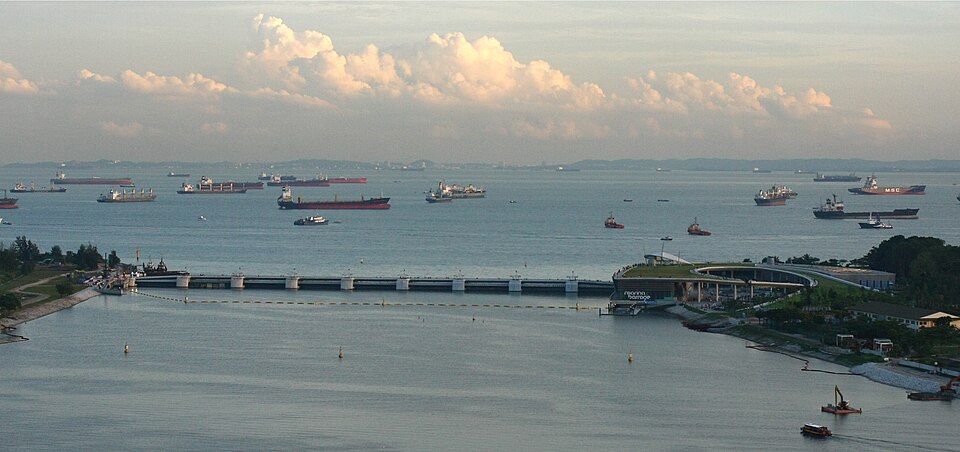
Singapore's Marina Barrage acts as both a freshwater reservoir and a flood-control structure, discharging excess stormwater into the sea during heavy rain
Lesson 2
Drainage infrastructure must evolve continuously with urban growth
As Singapore became more densely developed, its government continued upgrading drainage systems to account for changing rainfall intensity and increasing imperviousness. Singapore's Public Utilities Board reports nearly S$2 billion invested in drainage improvement works over the past decade alone.4 Flood resilience is treated as an ongoing capital programme rather than a one-time construction project. In Gurgaon, drainage capacity has frequently lagged behind development — new sectors and residential complexes have been built without corresponding expansion of the downstream drainage network.
Lesson 3
Preserve — and restore — natural water pathways
Many rapidly-growing cities cover streams, ponds and natural drainage channels in the name of development. Singapore has moved in the opposite direction. Through its Active, Beautiful, Clean (ABC) Waters Programme, canals and drainage corridors have been integrated into parks and public spaces while retaining their flood-management function.5 In several cases, concrete-lined canals have been transformed into naturalized rivers and wetlands. Gurgaon's natural nalas (drainage channels) have been encroached upon, built over or disconnected — breaking the pathways that once moved water across the landscape.
Lesson 4
Use data to anticipate problems before they become emergencies
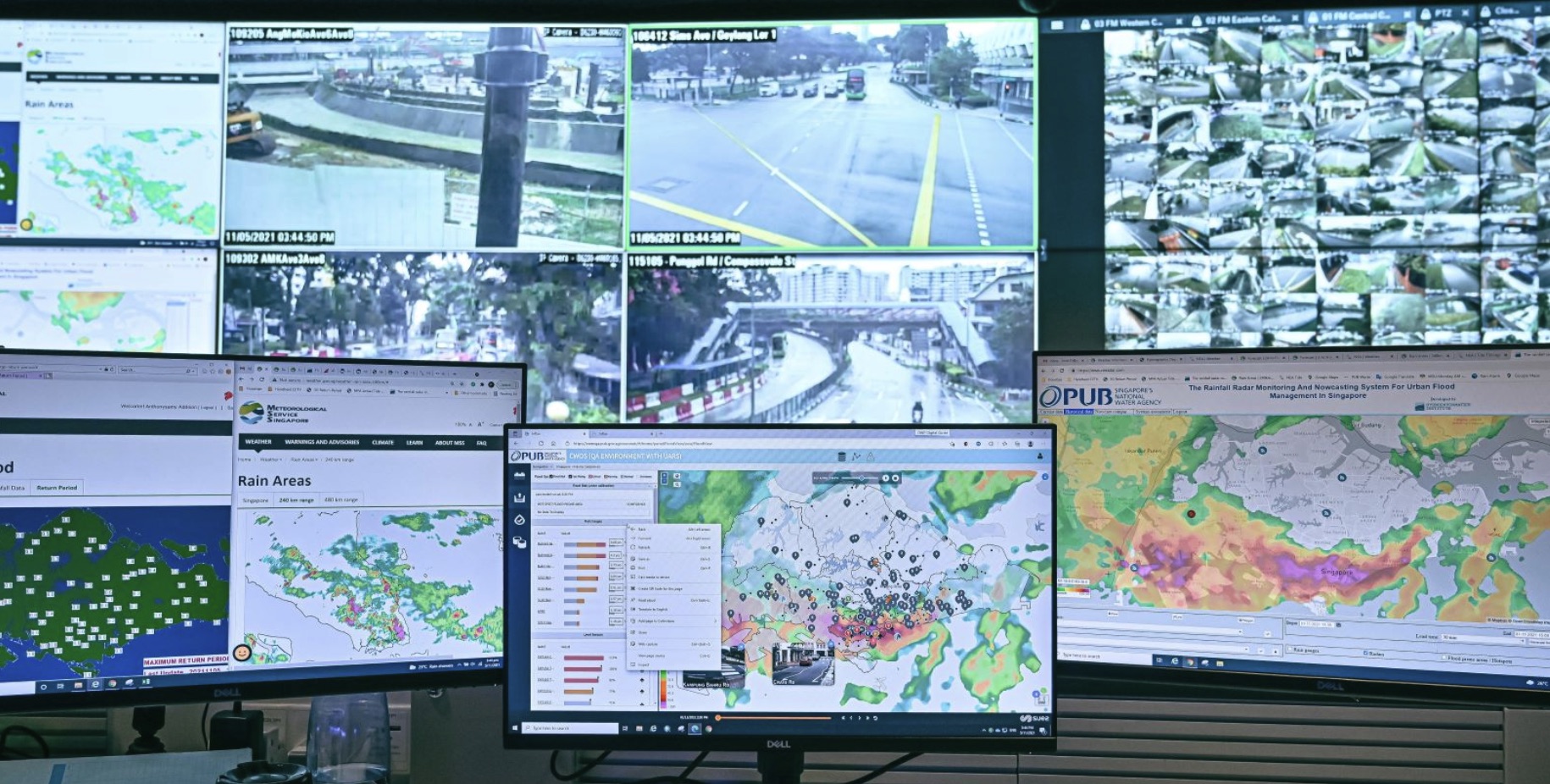
Singapore uses real-time rainfall monitoring, flood-forecasting models and sensor-based drainage management to anticipate bottlenecks before they cause street flooding. When a cloud burst is forecast, pumping capacity is pre-activated and field teams are deployed. The ability to act ahead of a problem — rather than scrambling in response to one — is itself a form of infrastructure. Our own experience building FloodWatch Gurgaon confirmed the value of this: elevation data, rainfall history and runoff modelling can identify which colonies will flood first, hours before it happens.
Monsoon flooding in Gurgaon — a recurring crisis that data and long-term planning can help address
Lesson 5
Institutional coordination matters as much as engineering
Singapore's biggest lesson may be institutional rather than technical. Flood management is coordinated through a single national water agency — the Public Utilities Board — with clear authority over drainage, stormwater and water resources, using a holistic "Source-Pathway-Receptor" framework that manages water at every stage of its journey across the city.6 Long-term planning horizons of 20–50 years are embedded in the mandate. In Gurgaon, responsibility for drainage is distributed across MCG, GMDA, HRERA, private developers and RWAs, with no single body holding end-to-end accountability. Coordination failures mean that a drain that works on paper may discharge into a nala that was narrowed by a neighbouring development, and no one is responsible for fixing the gap.
Gurgaon and Singapore are very different cities, and no solution transfers directly. Singapore is a city-state with full control over its territory; Gurgaon is one district in a state with many competing priorities. Singapore spent decades and billions solving this problem; Gurgaon would need a long-term commitment that spans multiple political cycles.
But the underlying principles are not expensive to adopt in thinking, even if they are expensive to implement in concrete. Preserve water bodies. Protect natural drainage channels. Invest continuously — not just after disasters. Use data to guide decisions. Assign clear institutional responsibility.
Flooding is not an inevitable consequence of rainfall. It is often the result of infrastructure, planning and policy choices made — or not made — over decades. Singapore's experience is a proof of concept that urban flooding can be reduced dramatically when cities treat water management as a long-term priority rather than a seasonal emergency.
Check flood risk for your area
FloodWatch covers 721+ localities in Gurgaon with Monsoon Readiness Scores, live advisories, and waterlogging hotspot data.
