
Every monsoon, the same scenes play out across Gurgaon: waterlogged roads, stalled vehicles, flooded underpasses, severe traffic jams and forced closure of schools and offices. Even brief showers are enough to cause pooling and waterlogging with often dangerous and fatal consequences for people.
But why does Gurgaon get flooded so easily? Singapore receives 4 times Gurgaon's rainfall (2,500mm vs. 600–700mm)1, year-round and often in heavy bursts but rarely experiences prolonged flooding. In fact, the speed with which normal life resumes in Singapore after a spell of rain is remarkable.
Gurgaon's flooding problem is the result of several interacting factors that we uncovered in our research:
Gurgaon has lost 389 of its 640 water bodies in the last 70 years according to a National Green Tribunal report.2 As these natural storage areas disappeared, rainwater had fewer places to go during heavy rainfall. These water bodies were built over or left to dry out as the city expanded.
Historically, rainwater moved through a network of natural drainage paths before reaching larger drains and water bodies. Over time, development altered many of these pathways. As these natural channels were built over or interrupted, rainwater lost the pathways that once carried it safely away.3
In normal times, ground is able to absorb a fair percentage of rainwater.4 However, with rapid urbanization that outpaced drainage infrastructure, water doesn't get absorbed and ends up pooling in localized low elevation spots — both natural and man-made (underpasses etc.)
Gurgaon has grown rapidly over the past three decades. While drainage infrastructure has expanded, drainage capacity has not always kept pace with development. During intense rainfall, water volumes exceed the system's ability to move water quickly enough. Worse, this water merges with sewerage and spills onto the streets. Drains are most often choked with waste, construction debris, silt and vegetation — creating conditions for mosquito breeding and water-borne disease outbreaks.
Gurgaon's relatively flat terrain5 leaves little room for gravity-assisted drainage. In well-planned cities this can be managed through engineered drainage systems, but where such systems are inadequate, water tends to accumulate in low-lying areas.
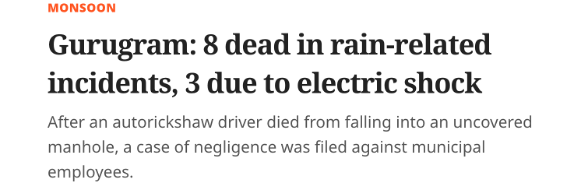
The consequences are not limited to inconvenience. Waterlogging damages roads, disrupts businesses, delays emergency services, increases accident risk and creates breeding grounds for mosquitoes and water-borne diseases.
To understand the scale of this risk, we built a risk model for Gurgaon's monsoon preparedness across its various colonies, sectors, villages and wards. This model used elevation data, simulated historical rainfall events and surface runoff routing to estimate waterlogging risk for each area. In addition, we calibrated this risk further with government identified waterlogging hotspots in Gurgaon. The results were striking. Of the 721 areas, >80% exhibit high or critical risk during monsoons.
The goal is not to alarm people. It is to make flooding visible, measurable and actionable. Gurgaon has the resources to solve this problem. The first step is understanding where the risks are and demanding the long-term infrastructure needed to address them.
FloodWatch covers 721+ localities in Gurgaon with Monsoon Readiness Scores, live advisories, and waterlogging hotspot data.